
How to Measure a Hydraulic Cylinder for Replacement
Replacing a hydraulic cylinder is not always as simple as finding one that looks similar.
A replacement cylinder needs to fit the machine, provide the required movement, and connect correctly to the existing hydraulic system.
If you do not have the original part number or drawing, you can still provide enough information for a manufacturer to identify or build a replacement.
The key is knowing what to measure.
In this guide, we will cover the main hydraulic cylinder measurements you should collect before ordering a replacement.
What Information Do You Need for a Hydraulic Cylinder Replacement?

Before contacting a supplier, try to collect the following information:
- Bore diameter
- Rod diameter
- Stroke length
- Retracted length
- Extended length
- Mounting dimensions
- Pin diameter
- Port size and thread type
- Working pressure
- Cylinder type
You do not always need to remove the cylinder to collect all of this information.
However, the more accurate the measurements are, the easier it is for a manufacturer to confirm the correct replacement.
1. Measure the Hydraulic Cylinder Bore

The bore is the inside diameter of the cylinder barrel.
It is an important dimension because bore size affects the force produced by the cylinder at a given hydraulic pressure.
If the cylinder is already disassembled, the bore can be measured directly with suitable measuring tools.
If the cylinder is still assembled, do not simply guess the bore from the outside diameter of the barrel.
The barrel wall thickness must also be considered.
For a replacement order, it is better to provide the original cylinder information, drawing, part number, or clear photos if the exact bore cannot be confirmed.
Measurement to record:
Bore: __ in / __ mm
2. Measure the Rod Diameter

The next important measurement is the piston rod diameter.
Use a caliper to measure the smooth section of the rod.
Try to measure a clean area that has not been damaged or heavily worn.
Do not measure the thread or mounting end of the rod.
A worn or damaged rod can give you an inaccurate reading, so it is useful to check the rod condition at the same time.
Measurement to record:
Rod Diameter: __ in / __ mm
3. Measure the Hydraulic Cylinder Stroke

The stroke is the distance the piston rod travels between the fully retracted and fully extended positions.
For example, if the cylinder moves from a fully retracted position to an extended position with 24 inches of rod travel, the cylinder has a 24-inch stroke.
If you can operate the cylinder safely, you can measure the movement of the same reference point between the two positions.
If the cylinder has been removed, you can also compare the extended and retracted dimensions.
A basic relationship is:
Extended Length − Retracted Length = Stroke
For replacement applications, stroke is especially important because the wrong stroke can change the movement of the equipment.
For a dump trailer, for example, an incorrect stroke may affect the available lifting angle.
Measurement to record:
Stroke: __ in / __ mm
4. Measure the Retracted Length
The retracted length, also called the closed length, is another critical dimension.
For a pin-mounted cylinder, measure from the center of one mounting pin to the center of the other mounting pin when the cylinder is fully retracted.
Do not simply measure the outside length of the barrel.
The mounting point-to-mounting point dimension is more useful when checking whether a replacement cylinder will physically fit the machine.
This measurement is particularly important when installation space is limited.
Measurement to record:
Retracted Length: __ in / __ mm
5. Check the Extended Length
If possible, record the cylinder’s extended length as well.
The extended length can be measured from the same mounting reference points when the cylinder is fully extended.
It also gives you a useful way to double-check the stroke measurement.
For example:
Retracted Length = 24 in Extended Length = 36 in Stroke = 12 in
If your numbers do not match, it is worth measuring again before placing the order.
6. Check the Mounting Style

Two cylinders can have similar dimensions but still be impossible to install because their mounting ends are different.
Common mounting configurations include:
- Clevis mounts
- Cross-tube mounts
- Trunnion mounts
- Flange mounts
- Threaded mounts
- Custom mounting ends
Take clear photos of both ends of the original cylinder.
Also record:
- Pin diameter
- Mounting width
- Hole diameter
- Mounting center distance
- Thread size, if applicable
Why Mounting Dimensions Matter
A replacement cylinder must not only have the correct stroke and bore.
It also needs to connect correctly to the equipment.
This is one reason why sending photos together with measurements can be very helpful when requesting a quotation.
7. Check the Hydraulic Ports

Do not forget the hydraulic ports.
Record the following information if possible:
- Port size
- Thread type
- Port location
- Port orientation
The connection must match the existing hydraulic hoses or fittings.
If you are not sure about the thread type, take a clear photo of the port and fitting.
A manufacturer can often use the photo together with the other dimensions to help identify the required configuration.
8. Check the Working Pressure
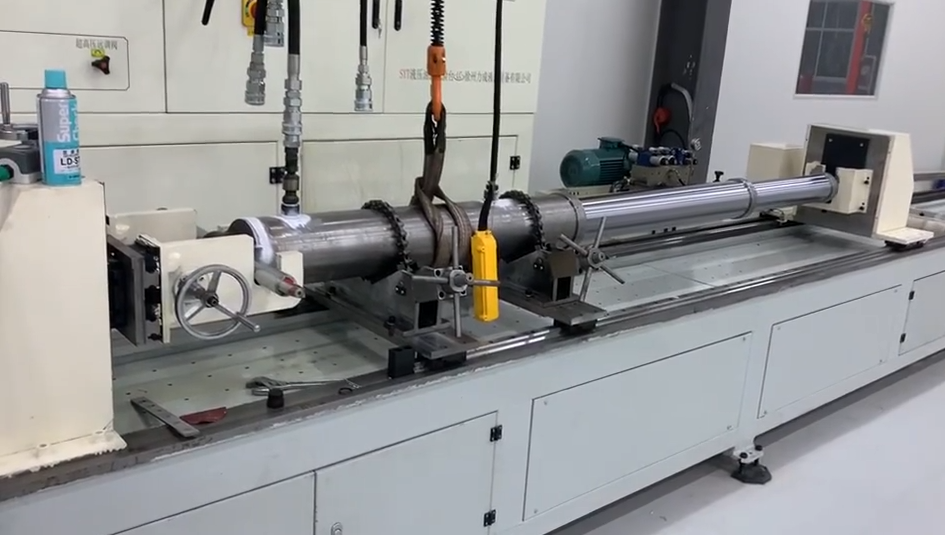
Dimensions alone are not enough to specify a replacement cylinder.
You should also provide the working pressure of the hydraulic system if it is known.
For example:
Working Pressure: __ PSI / __ MPa
The replacement cylinder should be designed for the actual application and hydraulic system.
This is especially important for equipment that works under high loads or frequent operating cycles.
9. Take Photos Before Ordering
If you are ordering a replacement cylinder and do not have a drawing, take several clear photos.
A useful photo set includes:
Photo 1: Full cylinder
Photo 2: Rod end
Photo 3: Cap end
Photo 4: Hydraulic ports
Photo 5: Mounting points
Photo 6: Nameplate or part number, if available
Photos can help a manufacturer understand details that are difficult to describe with measurements alone.
For older equipment, the original part number may no longer be available.
In this situation, measurements and photos can provide a practical starting point for a replacement cylinder.
What If You Do Not Have the Original Drawing?
This is common with older machines and replacement projects.
You do not always need the original manufacturer’s drawing.
A hydraulic cylinder manufacturer can review the available dimensions, photos and application information to determine whether a replacement or custom cylinder can be produced.
For OEM and replacement projects, you can also provide:
- Existing cylinder
- Product drawing
- CAD file
- Photos
- Machine model
- Application information
- Required quantity
If the cylinder has a special mounting configuration or unusual dimensions, a custom hydraulic cylinder may be a better solution than trying to modify a standard cylinder.
Hydraulic Cylinder Measurement Checklist
Before sending a replacement inquiry, use this simple checklist.
| Item | Measurement |
|---|---|
| Bore | __ |
| Rod Diameter | __ |
| Stroke | __ |
| Retracted Length | __ |
| Extended Length | __ |
| Pin Diameter | __ |
| Mounting Width | __ |
| Mounting Type | __ |
| Port Size | __ |
| Port Thread | __ |
| Working Pressure | __ |
| Cylinder Type | __ |
It is also a good idea to include several clear photos.
This information can save time when a supplier needs to confirm the correct cylinder design.
Measuring a Dump Trailer Hydraulic Cylinder
Dump trailers are a good example of why accurate cylinder measurement matters.
A dump trailer may use a telescopic hydraulic cylinder with multiple stages.
In this case, you need to consider the overall stroke, closed length, mounting configuration and available installation space.
The cylinder also needs to provide the required movement for the trailer bed.
If you are replacing a dump trailer hydraulic cylinder, provide the original cylinder dimensions together with photos of the mounting area.
For telescopic cylinders, it is also important to identify the number of stages and the overall collapsed and extended dimensions.
When Should You Consider a Custom Hydraulic Cylinder?
A custom cylinder may be worth considering when:
- The original cylinder is discontinued
- The original part number cannot be found
- The mounting dimensions are unusual
- The stroke is non-standard
- The cylinder needs a special port configuration
- The application requires a specific bore or rod diameter
- You need an OEM replacement based on a drawing
Instead of changing the machine to fit a standard cylinder, a manufacturer can review the application and develop a cylinder around the required dimensions.
For OEM projects, providing a drawing is usually the best starting point.
However, photos, measurements and application details can also help when no drawing is available.
Final Checklist Before Ordering a Replacement Cylinder

Before you send your inquiry, make sure you have:
- ✓ Bore diameter
- ✓ Rod diameter
- ✓ Stroke
- ✓ Retracted length
- ✓ Extended length
- ✓ Mounting dimensions
- ✓ Pin diameter
- ✓ Port information
- ✓ Working pressure
- ✓ Cylinder type
- ✓ Clear photos
- ✓ Drawing or part number, if available
The goal is not simply to find a cylinder that looks similar.
The replacement needs to match the dimensions, mounting points, hydraulic system and working requirements of the equipment.
If you are unsure about one of the measurements, it is better to provide the available information and photos and ask the cylinder manufacturer to review the application before ordering.
Frequently Asked Questions
Q1: How do I measure a hydraulic cylinder for replacement?
Measure the bore, rod diameter, stroke, retracted length, mounting dimensions, ports, and working pressure. Clear photos and the original drawing or part number can also help identify the correct replacement.
Q2: How do I measure hydraulic cylinder stroke?
Measure the distance the rod travels between fully retracted and fully extended positions. If both lengths are known, subtract the retracted length from the extended length.
Q3: How do I measure hydraulic cylinder bore?
The bore is the inside diameter of the cylinder barrel. If the cylinder is disassembled, the inside diameter can be measured directly. If it is assembled, provide the manufacturer with the available dimensions and photos.
Q4: What information do I need to order a replacement hydraulic cylinder?
Provide the bore, rod diameter, stroke, retracted length, mounting dimensions, port information, working pressure, cylinder type, and clear photos whenever possible.
Q5: Can a hydraulic cylinder be replaced without the original part number?
Yes. A replacement cylinder can often be specified using measurements, photos, application information and mounting details when the original part number is unavailable.
Need Help With a Hydraulic Cylinder Replacement?
If you have an old or damaged hydraulic cylinder but cannot find the original part number, you can send the dimensions, photos, drawing or application details for review.
HCIC provides custom hydraulic cylinder manufacturing for OEM and replacement applications.

 English
 Spanish (Peru)
 French
 German
 Russian
 Arabic
 Japanese
 Spanish (Spain)
 Portuguese
 Chinese